Why Data Quality Is the Hidden Bottleneck in AI Projects
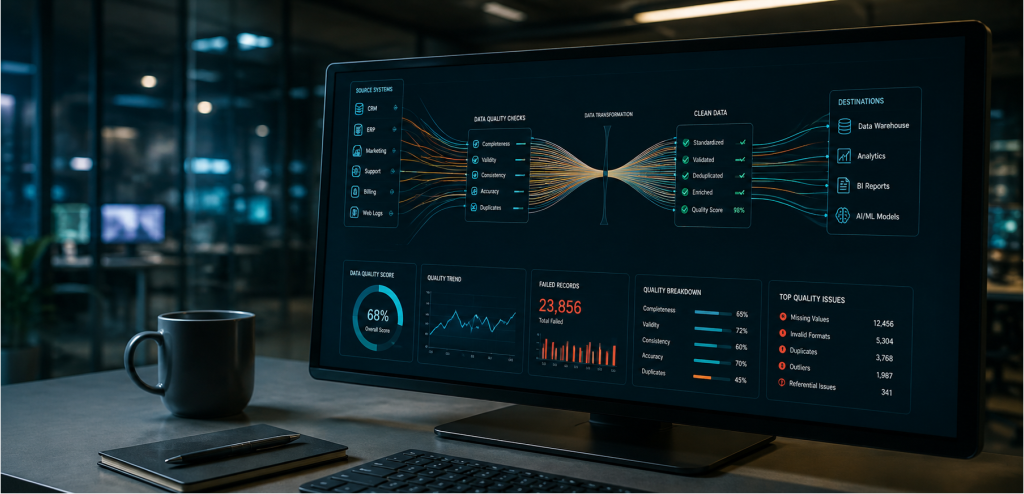
When an AI initiative slips a quarter, the retrospective usually points at model performance. In our work with enterprise data teams, the real cause is almost always further upstream: inconsistent identifiers, silently drifting schemas, and duplicate records that inflate every downstream metric. By the time anyone questions the model, the damage is already baked into months of training data.
Quality debt compounds quietly
A single unvalidated join in an ingestion job can propagate into dozens of derived tables. By the time a data scientist notices, the fix requires re-running weeks of history and re-training every model that consumed it. What starts as a small oversight in one pipeline turns into a multi-week remediation project touching teams that had nothing to do with the original mistake.
We call this quality debt because it behaves exactly like technical debt. It accrues interest. A schema that drifts unnoticed for a month is cheap to fix. The same drift left unnoticed for two quarters has already contaminated dashboards, model features, and possibly customer-facing reports. Every day it goes undetected raises the cost of the eventual cleanup.
Teams do not lose time fixing data. They lose time discovering that the data was wrong.
Make quality a contract, not a cleanup step
Treat every dataset as a published interface with explicit expectations: required fields, accepted ranges, freshness windows, and uniqueness guarantees. Enforce those expectations at ingestion time, score them continuously, and block promotion when the score drops. This reframes data quality from something a downstream team discovers the hard way into something the producing team is accountable for from the start.
In practice, this means writing down what 'good' looks like for a dataset before it ships, not after an incident forces the conversation. A contract might state that a customer ID column must never be null, that order totals must fall within a plausible range, or that a table must refresh within four hours of the source system. None of this is exotic. What matters is that the checks run automatically, on every batch, and that a failing check stops the data from moving forward.
Shift validation left, and measure the payoff
Teams that shift validation left typically see rework in analytics engineering fall by half within two quarters, because incidents are caught before they become dependencies. The pattern we see repeatedly is that the first month feels slower: engineers are writing contracts and fixing violations they previously never saw. By the third month, the volume of surprise incidents drops sharply, and the team spends its time building instead of firefighting.
The organizations that get the most value from AI are rarely the ones with the most sophisticated models. They are the ones that stopped treating data quality as a cleanup step and started treating it as the foundation everything else is built on.